EEOC Consent Decree
Sam’s Club to Pay $60,000 in Disability Discrimination Settlement
Background
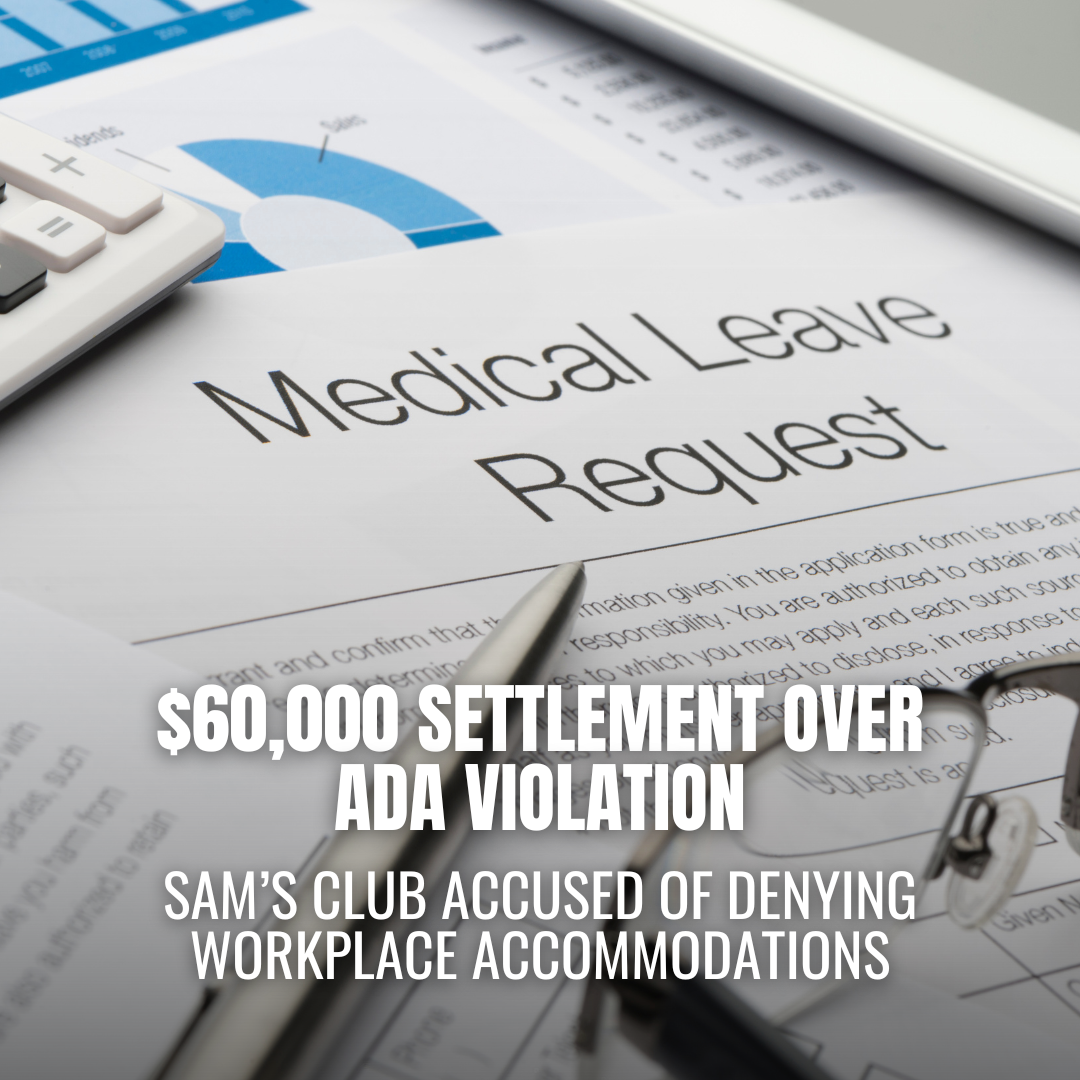
Sam’s Club, a division of Walmart Inc., has reached a $60,000 settlement with the U.S. Equal Employment Opportunity Commission (EEOC) after being accused of disability discrimination. The case stems from an incident at the retailer’s Douglasville, Georgia location, where a longtime employee was terminated after requesting workplace accommodations for medical restrictions.
Incident Details
The employee, who had worked for Sam’s Club for years, suffered injuries from an automobile accident that caused post-concussion syndrome, chronic back pain, and muscle spasms. After taking medical leave, she attempted to return to her role in June 2022 with minor, temporary adjustments to her job duties as a reasonable accommodation.
Initially, she was able to complete a work shift under these restrictions. However, her supervisor later informed her that she could not continue working with limitations. Instead, she was told to take an additional leave of absence until she could return without restrictions. The employee complied, submitting a medical timeline for her recovery. Despite this, Sam’s Club denied the requested leave and ultimately terminated her employment. The store’s general manager reportedly stated that her injuries would not be accommodated because they occurred outside of the workplace.
Legal Background
This conduct was found to violate the Americans with Disabilities Act (ADA), which prohibits employers from discriminating against qualified employees with disabilities and requires reasonable accommodations unless doing so would cause undue hardship. Importantly, the ADA does not allow employers to deny accommodations based on whether a disability occurred inside or outside of work.
The EEOC filed suit in the U.S. District Court for the Northern District of Georgia (Case No. 1:25-cv-00222-SCJ-CMS) after efforts to resolve the matter through conciliation were unsuccessful.
Settlement Terms
Under the terms of the consent decree, Sam’s Club will:
- Pay $60,000 in monetary relief to the affected employee.
- Post a workplace notice at the Douglasville location informing employees of their rights under the ADA and the terms of the settlement.
- Provide training to supervisors, managers, and human resources staff at the store, with emphasis on handling accommodation requests properly and understanding that the source of a disability does not affect entitlement to accommodations.
- Submit periodic reports to the EEOC regarding any future denials of accommodation requests at the Douglasville store, including explanations for those decisions.
Key Takeaways
- Source of disability is irrelevant – Employers must evaluate accommodation requests based on need and feasibility, not how the disability originated.
- Firing instead of accommodating violates the ADA – Employers cannot terminate workers for having medical restrictions if reasonable accommodations are available.
- Training and compliance are critical – Employers must ensure supervisors and HR personnel understand ADA requirements to avoid future violations.
Conclusion
The Sam’s Club settlement underscores the importance of ADA compliance in workplace practices. Employers must evaluate accommodation requests fairly, provide flexibility when feasible, and ensure their managers are trained to recognize and respect employees’ rights. Failure to comply with federal disability protections can result in financial penalties, mandated training, and ongoing government oversight.