TAP Series Blog
Understanding Mortgage Interest Rates and How They Affect Your Buying Power
For many people, purchasing a home is one of the largest financial commitments they will ever make. While home prices often receive the most attention, mortgage interest rates play an equally important role in determining what a buyer can afford.
Even small changes in interest rates can significantly impact monthly mortgage payments, the total cost of borrowing, and the range of properties a buyer may realistically consider. As a result, understanding how mortgage interest rates work is an important part of making informed home-buying decisions.
Whether you are a first-time homebuyer, planning a future purchase, or exploring investment properties, learning how interest rates influence buying power can help you better evaluate your options and prepare financially.
What Is a Mortgage Interest Rate?
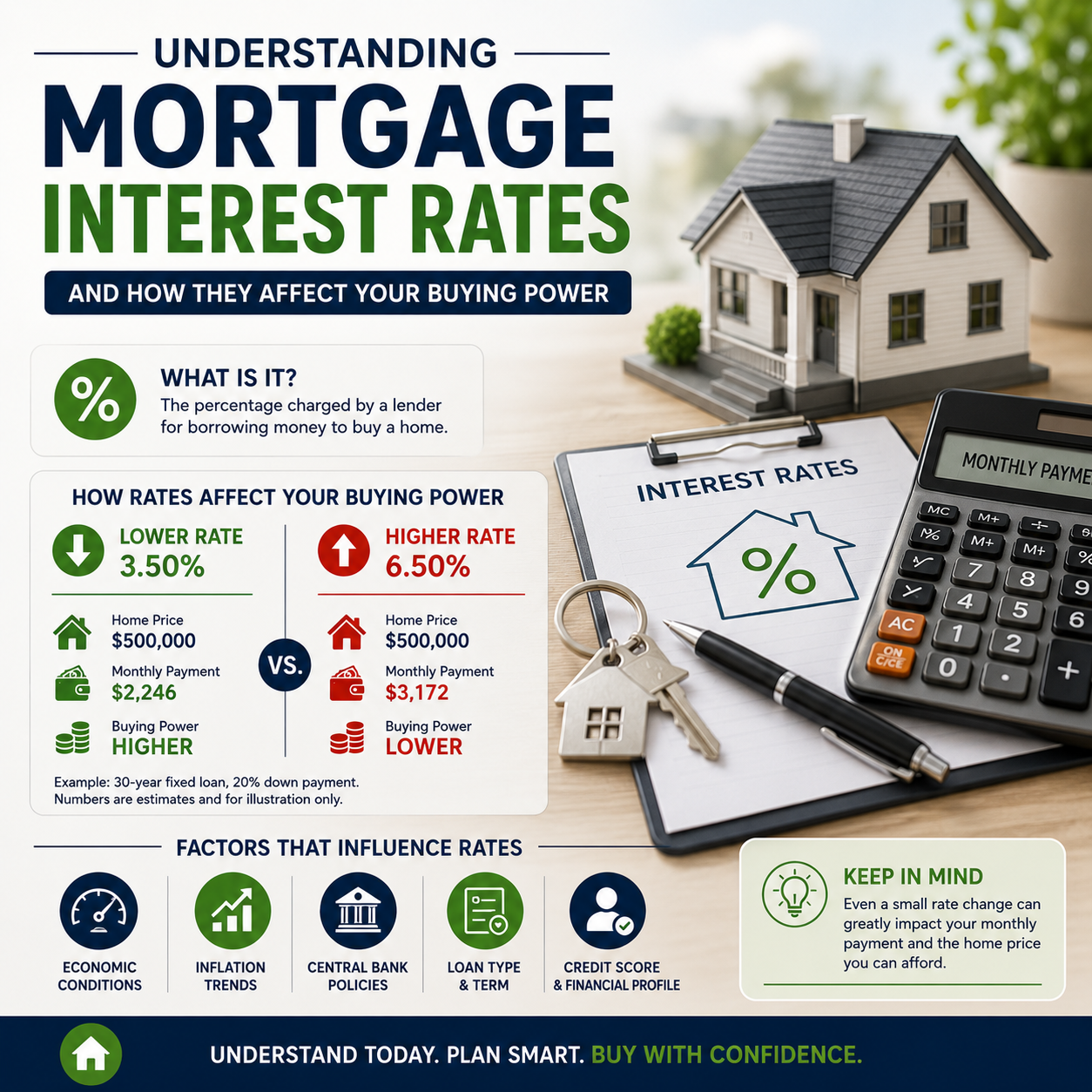
A mortgage interest rate is the percentage charged by a lender for borrowing money to purchase a property. In simple terms, it represents the cost of financing a home through a mortgage loan.
When buyers make monthly mortgage payments, a portion typically goes toward repaying the borrowed amount, known as the principal, while another portion goes toward interest.
For example, if someone borrows money to purchase a home, the lender charges interest in exchange for providing that loan. The interest rate determines how much that borrowing will cost over time.
Mortgage interest rates can vary based on several factors, including:
- Economic conditions
- Inflation trends
- Central bank policies
- Loan type
- Loan term
- Credit profile
- Down payment amount
While buyers cannot control broader economic conditions, understanding how rates affect affordability can help them make more informed decisions.
Why Mortgage Interest Rates Matter
Many buyers focus primarily on the purchase price of a property. However, the mortgage interest rate often has a significant impact on the total cost of homeownership.
A higher interest rate means:
- Larger monthly mortgage payments
- Increased borrowing costs over the life of the loan
- Reduced purchasing power
A lower interest rate generally means:
- Lower monthly payments
- Reduced long-term borrowing costs
- Greater purchasing flexibility
Because mortgages often span 15, 20, or 30 years, even small rate differences can result in substantial cost variations over time.
Understanding Buying Power
Buying power refers to the amount of property a buyer can reasonably afford based on their income, savings, debt obligations, and financing terms.
Mortgage interest rates directly influence buying power because they affect monthly payment calculations.
Consider a simplified example:
Imagine two buyers with the same income and financial profile.
Buyer A qualifies for a mortgage with a lower interest rate.
Buyer B qualifies for a mortgage with a higher interest rate.
Although both buyers earn the same income, Buyer A may be able to afford a higher-priced property while maintaining a similar monthly payment.
This illustrates why interest rates are often viewed as one of the most important factors affecting housing affordability.
How Higher Interest Rates Can Impact Affordability
When interest rates rise, borrowing becomes more expensive.
As monthly mortgage payments increase, buyers may need to:
- Lower their home price expectations
- Increase their down payment
- Consider different locations
- Adjust their housing budget
For some households, higher rates may reduce the number of available properties that fit comfortably within their financial plans.
This does not necessarily mean buyers should delay purchasing a home. Instead, it highlights the importance of evaluating affordability carefully and understanding how financing costs fit into overall financial goals.
How Lower Interest Rates Can Affect the Market
Lower mortgage interest rates can improve affordability by reducing monthly borrowing costs.
As financing becomes more accessible, more buyers may enter the market. Increased demand can sometimes contribute to higher property prices, particularly in areas where housing inventory remains limited.
This creates an interesting balance.
While lower rates can reduce monthly payments, rising demand may increase competition and property prices.
For this reason, mortgage rates should be considered alongside broader market conditions rather than viewed in isolation.
Fixed-Rate vs. Variable-Rate Mortgages
When researching home financing, buyers may encounter different mortgage structures.
Fixed-Rate Mortgages
A fixed-rate mortgage maintains the same interest rate throughout the loan term.
Potential benefits include:
- Predictable monthly payments
- Easier budgeting
- Protection from future rate increases
However, fixed-rate loans may initially have higher rates compared to some variable-rate options.
Variable-Rate Mortgages
A variable-rate mortgage has an interest rate that may change over time based on market conditions.
Potential advantages may include:
- Lower initial rates in some situations
- Reduced payments if rates decline
Potential risks include:
- Payment increases if rates rise
- Greater uncertainty for budgeting purposes
The right option depends on individual circumstances, financial goals, and risk tolerance.
Factors That Influence Mortgage Readiness
While market rates affect everyone, individual financial factors also play a role in mortgage eligibility and financing terms.
Buyers often benefit from reviewing:
- Credit Health
A strong credit history may improve access to more favorable financing options. Lenders often use credit information to assess borrowing risk.
- Debt-to-Income Ratio
This ratio compares monthly debt obligations to income. Lower debt levels may improve affordability and borrowing capacity.
- Down Payment Size
A larger down payment reduces the amount borrowed and may improve loan terms in certain situations.
- Financial Stability
Consistent income, emergency savings, and responsible financial management can strengthen overall mortgage readiness.
Questions Buyers Should Consider
Before purchasing a property, it can be helpful to evaluate several questions:
- How would different interest rate scenarios affect my monthly budget?
- Can I comfortably manage housing costs alongside other financial goals?
- Do I have adequate savings beyond the down payment?
- How might future financial changes affect affordability?
- Am I purchasing based on long-term needs rather than short-term market conditions?
Asking these questions can help buyers make more balanced and informed decisions.
Looking Beyond the Interest Rate
While mortgage interest rates are important, they represent only one part of the home-buying equation.
Buyers should also consider:
- Property taxes
- Homeowners insurance
- Maintenance expenses
- Utility costs
- Emergency repairs
- Future financial goals
A lower interest rate does not automatically make a property affordable if other ownership costs strain the household budget.
Evaluating the complete financial picture often provides a more accurate understanding of long-term affordability.
Final Thoughts
Mortgage interest rates play a significant role in determining buying power, housing affordability, and the overall cost of homeownership. Understanding how rates affect monthly payments and borrowing costs can help buyers approach the property market with greater confidence and financial awareness.
While no one can fully predict future interest rate movements, buyers can benefit from focusing on factors within their control, including budgeting, savings, debt management, and financial preparedness.
Ultimately, a well-informed home purchase is not simply about securing a mortgage. It is about understanding how financing fits into a broader financial plan and choosing a property that aligns with both current needs and long-term goals.