Data Center Planning And Approval Process
Cell Phone Towers and Data Centers Share the Same “Not Near Me” Problem
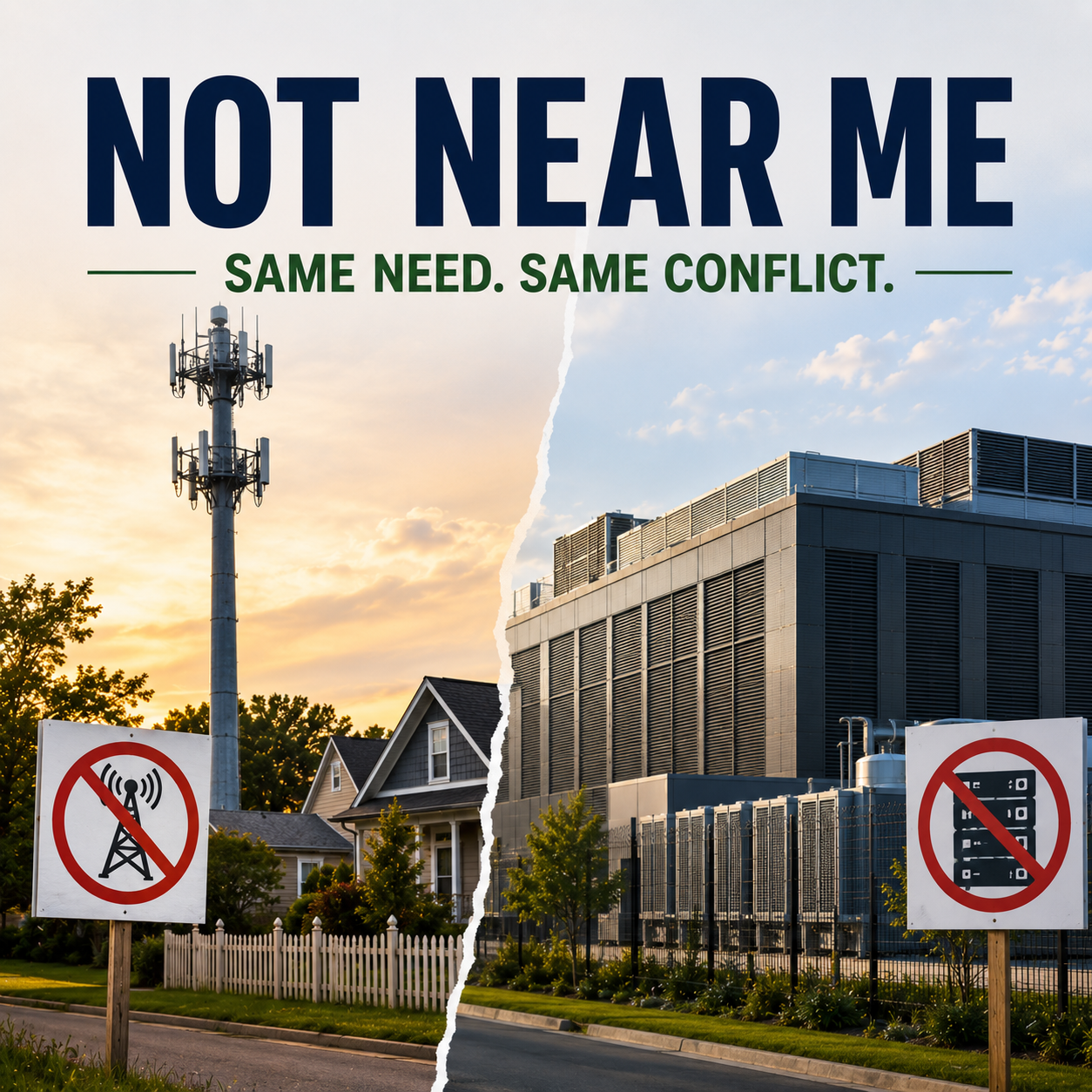
Cell phone towers created one of the clearest examples of modern infrastructure conflict.
People wanted better cell service. They wanted fewer dropped calls, faster mobile internet, emergency access, and reliable communication. Businesses wanted stronger networks. Families wanted phones that worked everywhere.
But when a tower was proposed near a neighbourhood, school, church, farm, or scenic area, many people objected.
The message was simple: we want the service, but we do not want the structure near us.
Data centers now face a similar problem.
Everyone Uses the Network
Cell phone towers became necessary because mobile communication became part of everyday life. At first, cell phones were convenient. Then they became essential.
Today, people use mobile networks for:
- banking
- work
- navigation
- school
- emergency alerts
- health care
- business communication
- family safety
Data centers are following the same path.
They support the systems that people now rely on every day:
- cloud storage
- artificial intelligence
- online learning
- digital certificates
- business records
- streaming
- banking
- government systems
- restaurant and retail software
- cybersecurity
- remote work
Like cell towers, data centers support services that many people do not want to live without.
The Physical Structure Creates the Conflict
The problem with cell towers was not always the service. It was the physical placement.
Residents often objected to towers because they affected views, changed the appearance of the area, raised property value concerns, or seemed too close to homes and schools.
Some people also raised health concerns, even when companies argued that the towers complied with federal standards.
Data centers create a different physical concern, but the pattern is similar.
Instead of a tower, the community may see a large building. Instead of signal equipment, it may hear cooling systems. Instead of visual height, it may worry about:
- power lines
- substations
- water use
- backup generators
- industrial zoning
The same question appears again: where should essential infrastructure be placed?
One Landowner Benefits, Others Live With the Impact
Cell tower disputes often involved one property owner agreeing to lease land for a tower. That property owner received payment. The wireless company received coverage. Customers received better service.
But neighbours might receive no payment while living with the visual impact.
This created a fairness problem.
Data centers can create the same issue on a larger scale.
One landowner may sell land. A developer may receive approval. A local government may receive tax revenue. A technology company may gain computing capacity. A utility may gain a major customer.
But nearby residents may experience:
- construction
- noise
- traffic
- water concerns
- land-use changes without receiving direct compensation.
That does not automatically mean the project should be rejected. But it does mean the community will ask whether the arrangement is fair.
Local Control Versus Infrastructure Need
Cell tower disputes also raised a major public-policy issue: how much control should local governments have over infrastructure that serves broader public needs?
Telecommunications companies often argued that local restrictions delayed network expansion. Communities argued that they had the right to control zoning, appearance, safety review, and neighbourhood character.
Data centers raise a similar issue.
State and national leaders may see data centers as critical infrastructure for:
- economic development
- artificial intelligence
- national security
- business competitiveness
Local residents may see them as resource-intensive industrial facilities that should be carefully reviewed before approval.
Both views can be true.
The challenge is creating a process that respects the need for infrastructure while protecting local communities.
The Lesson for Data Centers
Cell phone towers show that people may support a technology while opposing poor siting.
This is an important lesson for data center developers and public officials. They should not assume that opposition means people are against technology. Residents may simply want better planning, better location choices, and better protections.
A fair process should answer:
- Why this location?
- What alternatives were considered?
- What will the community receive?
- What impacts will nearby residents experience?
- What standards will be enforced?
- Who will be responsible if problems occur?
Cell towers became accepted over time because they became necessary, but the siting fights never fully disappeared. Data centers may follow the same path unless communities are included earlier and more honestly.