Shared Driveway Rights And Responsibilities
What Buyers Should Know About Shared Driveways Before Buying a Home
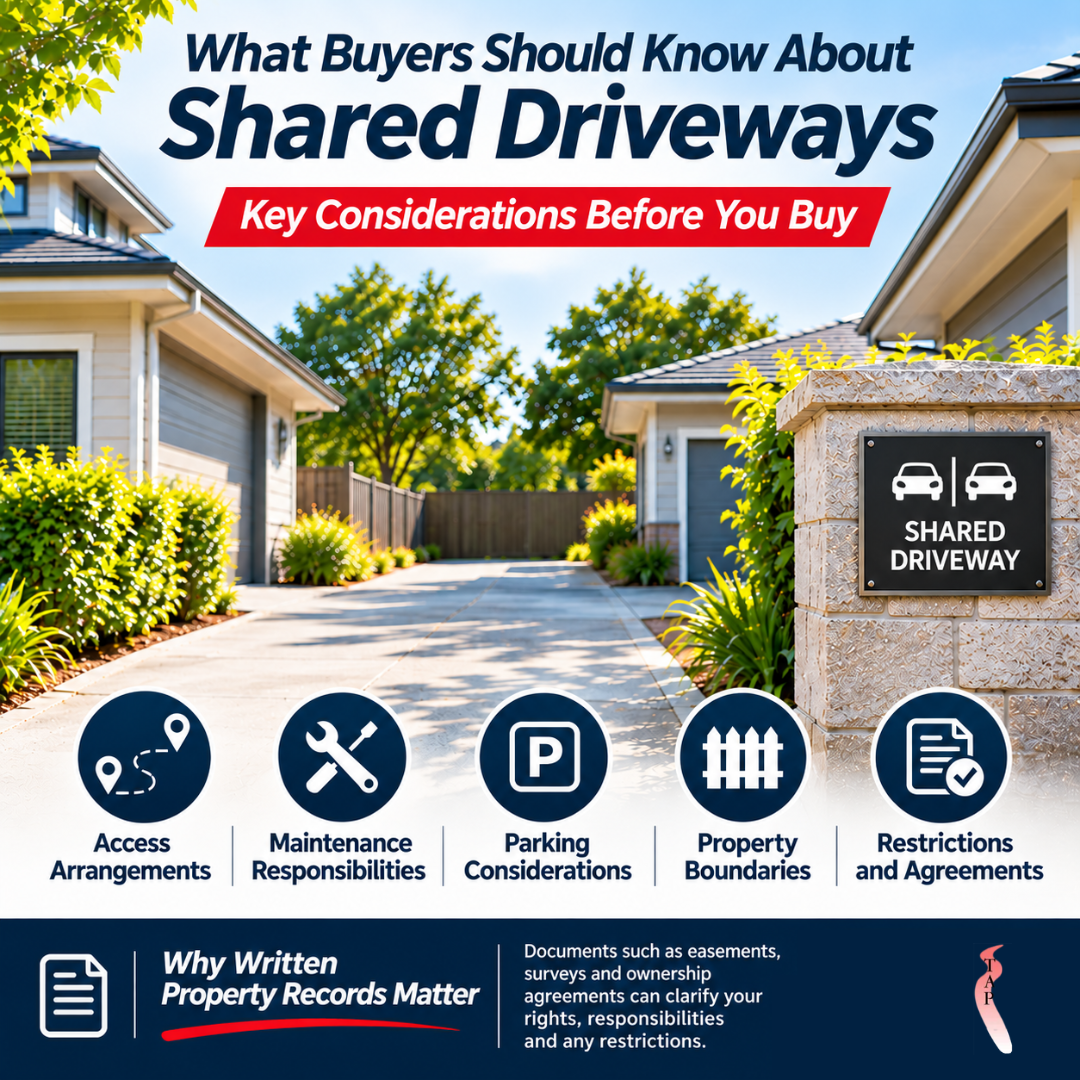
When evaluating a property, buyers often consider its location, layout, condition, and outdoor space. However, access arrangements can be just as important, particularly when a driveway is shared between neighboring properties.
Shared driveways are common in certain residential developments, including duplexes, townhouses, and properties built on subdivided land. While they can provide convenient access and make efficient use of limited space, they may also involve shared maintenance responsibilities, parking restrictions, and questions about property boundaries.
Understanding how shared driveways work can help prospective buyers evaluate everyday convenience, potential limitations, and the importance of written property records before purchasing.
What Is a Shared Driveway?
A shared driveway is an access route used by two or more properties.
It may provide access from a public road to separate garages, parking spaces, or residential entrances.
Shared driveway arrangements can differ considerably. In some cases, one property owns the land while neighboring properties have documented rights to use it. In others, multiple owners may share ownership or have access rights established through recorded agreements.
These arrangements may involve easements, shared ownership provisions, or other property-specific documents.
The driveway's physical appearance does not necessarily establish who owns it or what each household is permitted to do. Buyers should review the relevant records to understand the arrangement.
Understand Property Access Rights
One of the most important considerations is whether the property has documented access rights.
An easement may allow a property owner to use a designated portion of another property's land for access.
For example, a home located behind another residence may depend on a driveway crossing the front property's land.
However, the scope of access rights can vary. Some agreements address vehicle access, while others may include pedestrian access, maintenance activities, or specific limitations.
Buyers should not assume that longstanding use automatically establishes unrestricted access.
Written property records can help clarify the rights associated with the driveway and whether those rights continue when ownership changes.
Consider Parking and Vehicle Movement
Shared driveways can influence how residents park and move vehicles.
Some driveways are wide enough for two vehicles to pass, while others accommodate only one vehicle at a time.
A narrow driveway may require households to coordinate vehicle movements, particularly when several residents use the same access route.
Buyers should consider whether vehicles can enter and exit conveniently without obstructing neighboring properties.
It is also important to distinguish between access rights and parking rights. Permission to drive across a shared driveway does not necessarily include permission to park on it.
Depending on the arrangement, parking may be restricted to designated spaces.
Buyers should evaluate whether the existing layout accommodates their household's vehicles and everyday transportation needs.
Clarify Maintenance Responsibilities
Driveways require maintenance over time, regardless of whether they are privately or jointly used.
Common maintenance activities include repairing cracks, addressing potholes, maintaining drainage, clearing debris, and replacing deteriorated surfaces.
Shared arrangements may create uncertainty about who is responsible for these activities.
For example, an agreement might require neighboring owners to divide certain maintenance expenses or assign responsibility for particular sections.
However, there is no single arrangement that applies to every shared driveway.
Buyers should investigate whether written maintenance provisions exist and how responsibilities are allocated.
Understanding these details can help households anticipate potential expenses and avoid relying on informal assumptions.
Review Property Boundaries
Property boundaries are particularly important when a driveway crosses or runs alongside neighboring land.
A driveway may appear to belong equally to two properties even when the legal boundary places most or all of it within one parcel.
Fences, landscaping, and paving edges do not necessarily identify the official property line.
Buyers can review available surveys, subdivision plans, and recorded property documents to understand the driveway's location.
Boundary information may also help clarify whether nearby landscaping, fences, or structures affect the access route.
When records are unclear, a qualified land surveyor may be able to provide additional information.
Understand Potential Restrictions
Shared driveway arrangements may include restrictions intended to preserve access and prevent obstruction.
Depending on the applicable documents, limitations could involve:
- Parking or storing vehicles in shared areas.
- Installing gates, fences, or other barriers.
- Placing garbage bins or personal belongings along the driveway.
- Changing the driveway's surface or layout.
- Carrying out construction that affects access.
- Using the driveway for activities beyond its documented purpose.
These restrictions may influence how homeowners use or modify their property.
For example, installing a new gate or expanding a parking area could affect neighboring access rights.
Buyers should review existing restrictions before assuming that future changes will be permitted.
Consider Drainage and Surface Conditions
The physical condition of a shared driveway can affect both convenience and maintenance costs.
Cracked pavement, uneven surfaces, poor drainage, and inadequate grading may create problems over time.
Rainwater may collect in low areas or flow toward neighboring buildings, particularly where drainage systems are poorly maintained.
Buyers can look for standing water, damaged pavement, erosion, or visible repairs during a property viewing.
However, a visual inspection may not reveal every underlying issue.
Understanding the driveway's condition and available maintenance history can help buyers anticipate future responsibilities.
Why Written Property Records Matter
Informal arrangements between neighbors may work well for years, but verbal understandings do not necessarily establish the rights and responsibilities of future owners.
Written records provide a more reliable basis for understanding shared driveway arrangements.
Relevant documents may include recorded easements, property surveys, title documents, subdivision plans, and maintenance agreements.
These records can help buyers determine who owns the driveway, who may use it, and what restrictions apply.
They may also clarify whether maintenance costs are shared and how access must be preserved.
Because property laws and recording requirements vary by location, buyers should verify relevant information through appropriate local records and qualified professionals when necessary.
How Shared Driveways Affect Everyday Living
Beyond ownership and maintenance, shared driveways can influence daily household routines.
For example, residents may need to coordinate access when moving large furniture, receiving deliveries, or arranging home maintenance services.
Households with multiple vehicles may also need to consider how visitors, service providers, and other users enter and leave the property.
In some situations, a shared driveway may provide convenient access without creating significant inconvenience. In others, limited space or unclear usage arrangements may require additional planning.
The practical experience depends on the driveway's width, layout, number of users, and documented restrictions.
Buyers should consider how the arrangement fits their household's transportation needs and regular activities.
Consider Future Improvements and Property Changes
Shared driveways may affect plans for property improvements.
Projects such as installing a new garage, expanding a parking area, replacing driveway paving, or modifying landscaping could influence access for neighboring properties.
Even improvements located entirely within one property may affect drainage, vehicle movement, or the usability of the shared route.
For example, widening a driveway entrance might require changes to existing landscaping or drainage features.
Buyers should research whether proposed improvements are consistent with recorded agreements and applicable local requirements.
Understanding these limitations early can help homeowners develop realistic expectations about future modifications.
Evaluating the Long-Term Suitability of a Shared Driveway
A shared driveway should be evaluated as part of the property's overall functionality rather than viewed only as an access feature.
Buyers may benefit from considering the number of households using the driveway, its physical condition, available parking, and the clarity of documented responsibilities.
A well-maintained driveway with clearly established access arrangements may function conveniently for multiple households.
However, limited parking, deteriorated surfaces, or incomplete documentation may introduce additional considerations.
The goal is not to assume that shared access creates problems, but to understand how the arrangement could affect everyday convenience and future ownership responsibilities.
Conclusion
A shared driveway can provide practical access to residential properties, particularly where space is limited or homes are arranged on subdivided land.
However, buyers should understand how ownership, access rights, parking, maintenance, and property boundaries affect everyday use.
Written property records are especially important because the visible driveway layout may not reflect the rights and responsibilities associated with it.
By researching shared property access arrangements and reviewing available documentation, prospective homeowners can better understand the practical considerations of purchasing a home with a jointly used driveway.
This article is intended for general educational purposes only and does not constitute legal, property surveying, real estate, or financial advice. Access rights, maintenance responsibilities, and property regulations vary by jurisdiction.