Water Supply Considerations For Homebuyers
How to Assess a Property's Water Supply and Quality
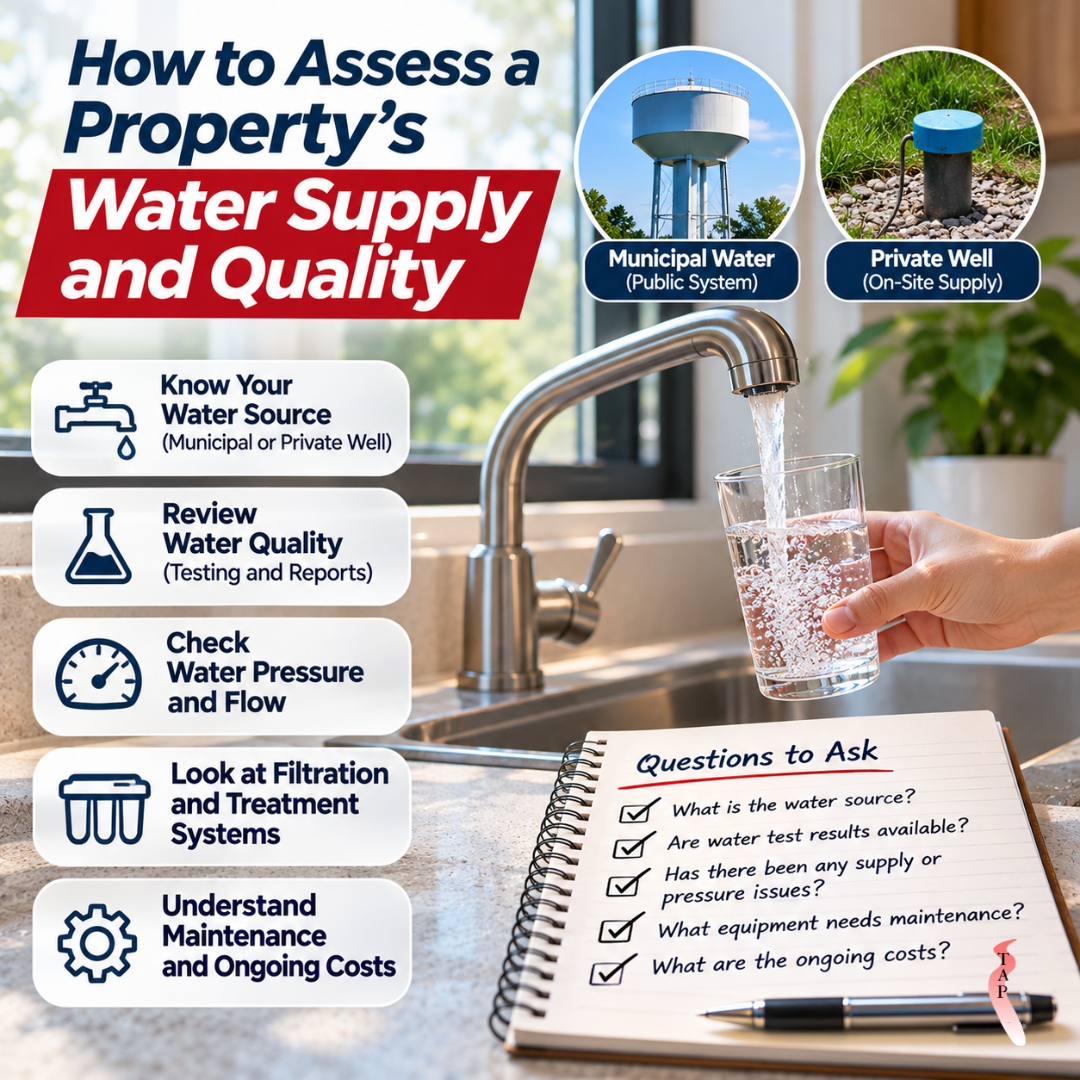
A reliable water supply is essential for everyday activities, including drinking, cooking, bathing, cleaning, and laundry. However, water availability and quality can vary between properties depending on the source, infrastructure, surrounding environment, and maintenance history.
For prospective buyers, understanding how to assess a property's water supply and quality can help identify potential concerns before purchasing. Whether a home receives municipal water or relies on a private well, it is important to investigate water pressure, testing records, filtration systems, supply reliability, and ongoing maintenance responsibilities.
Understand the Property's Water Source
One of the first questions buyers should ask is where the property's water comes from.
Most residential properties receive water through a municipal or public water system, while some homes rely on private wells or other independent sources.
Municipal water systems generally collect, treat, and distribute water through a public or regulated utility network. These systems are typically subject to water quality standards and routine monitoring, although service interruptions and infrastructure problems can still occur.
Private wells draw groundwater from underground sources. The property owner is generally responsible for maintaining the well, arranging appropriate water testing, and managing equipment such as pumps and pressure tanks.
Neither water source should be assumed to be problem-free. The important consideration is understanding how the system operates, who maintains it, and what information is available about its condition.
Review Water Quality and Testing Records
Water may appear clear and have no noticeable odor while still containing substances that cannot be detected through sight, taste, or smell.
For homes connected to municipal water, buyers can review available water quality reports from the local utility. These reports may provide information about regulated contaminants, treatment methods, and testing results.
For properties with private wells, recent laboratory testing is particularly important because routine testing is generally the owner's responsibility.
Depending on local conditions, relevant tests may include bacteria, nitrates, arsenic, lead, and other contaminants associated with groundwater or plumbing materials.
Testing requirements and recommendations vary by location. Local health authorities or qualified water testing professionals can help identify appropriate tests.
Buyers should also understand that a previous satisfactory test does not establish that water quality will remain unchanged. Seasonal conditions, nearby activities, flooding, and changes in plumbing can influence results.
Check Water Pressure and Flow
Water pressure and flow can affect the practical use of showers, faucets, washing machines, and other household fixtures.
During a property viewing, buyers can ask permission to test several faucets and observe whether water flows consistently.
Weak pressure may result from plumbing restrictions, leaks, pressure regulation issues, or limitations in the water supply system.
For homes with private wells, inconsistent pressure may also involve the pump, pressure tank, or available groundwater supply.
Excessively high pressure can create problems as well, potentially placing additional strain on pipes and fixtures.
A basic viewing cannot determine the exact cause of pressure concerns. If water flow appears unusually weak, inconsistent, or excessive, a qualified plumbing professional can assess the system.
Evaluate Water Supply Reliability
Water quality is important, but buyers should also consider whether the property has a dependable supply throughout the year.
Municipal water users may experience occasional service interruptions due to maintenance, infrastructure repairs, or local supply restrictions.
Private well users may face different concerns, including seasonal groundwater changes, pump failures, or reduced well output during dry periods.
Buyers considering a well-served property should ask about the well's age, depth, available yield or flow test records, and any history of supply shortages.
It is also useful to understand whether the well depends on electricity. During a power outage, an electric well pump may stop operating unless an appropriate backup system is available.
In areas experiencing recurring drought or water restrictions, local supply conditions may deserve additional research.
Understand Filtration and Water Treatment Systems
Some homes have water filtration or treatment equipment designed to address particular water quality concerns or improve household convenience.
Common examples include sediment filters, activated carbon filters, water softeners, ultraviolet disinfection systems, and reverse osmosis equipment.
These systems perform different functions. A water softener, for example, primarily addresses hardness minerals, while other equipment may be designed to reduce specific contaminants.
Buyers should ask why the treatment system was installed and whether water testing supports its intended purpose.
It is also important to review maintenance requirements. Filters, lamps, membranes, and other components may require regular replacement or servicing.
The presence of filtration equipment does not automatically mean the untreated water is unsafe. Likewise, a filtration system does not guarantee that all contaminants have been removed.
Understanding the equipment's capabilities and maintenance history can help buyers assess its practical value.
Inspect Plumbing and Water Storage Components
The condition of a property's plumbing can influence water quality, pressure, and reliability.
Older pipes, corroded fittings, leaks, and poorly maintained storage tanks may affect how water reaches household fixtures.
During a viewing, look for visible corrosion, water stains, leaking connections, and unusual discoloration when water is running.
Ask whether the plumbing has been replaced or significantly repaired and whether documentation is available.
For homes with water storage tanks, consider the tank's condition, cleaning history, protective covers, and maintenance arrangements.
Properties using private wells may also have pressure tanks, pumps, and other equipment that require periodic inspection.
A professional plumbing assessment can help identify concerns that may not be visible during a general property viewing.
Consider Maintenance Responsibilities and Ongoing Costs
Water supply arrangements can create different responsibilities for homeowners.
Municipal water customers generally pay utility charges and may be responsible for certain plumbing components or service lines, depending on local rules.
Private well owners typically manage well inspections, water testing, pump servicing, treatment equipment, and repairs.
These responsibilities may involve periodic expenses as well as occasional major equipment replacement.
Buyers should also consider whether the property has water treatment equipment that requires consumables, electricity, or specialist servicing.
Understanding these costs helps provide a more complete picture of homeownership expenses beyond the purchase price.
Practical Questions to Ask Before Buying
A simple set of questions can help buyers investigate the property's water supply more effectively:
- What is the water source? Is the property connected to a municipal system, private well, or another supply arrangement?
- Are water quality reports available? When was the water last tested, and what did the results show?
- Has the property experienced supply problems? Are there records of low pressure, interruptions, shortages, or contamination concerns?
- What equipment requires maintenance? Are there pumps, pressure tanks, storage tanks, filters, or treatment systems?
- Who is responsible for repairs? Which components are maintained by the utility, property owner, or another organisation?
- Are there location-specific concerns? Could drought, flooding, nearby land uses, or ageing infrastructure affect the supply?
Buyers can use the answers to identify areas requiring additional documentation or professional assessment.
Making an Informed Water Supply Assessment
A property's water supply should be evaluated as part of its overall condition and everyday suitability.
Municipal connections and private wells have different maintenance arrangements, but both require attention to water quality, pressure, reliability, and plumbing condition.
By reviewing available records, observing water performance, understanding treatment equipment, and considering ongoing responsibilities, buyers can develop a clearer picture of the property's water system.
Where information is incomplete or concerns arise, appropriate water testing and professional inspection can provide additional insight.
A careful assessment helps buyers understand whether the property's water supply is suitable for their household's needs and what responsibilities may come with maintaining it.
This article is for general educational purposes only and is not a substitute for professional water quality testing, plumbing inspection, legal, or financial advice.